city cycling in Danmark

I’ve not long returned from spending eight days in Denmark. I visited four cities and travelled between them by inter-city trains. Each of the trains I was on had compartments for cycles. Those needed to be reserved in advance. They were mostly well used with people using them for both short journeys and touring cyclists with camping gear on the longer journeys. The carriages were laid out with fold up seats which the bikes were strapped in front of. As Danish trains are wider than ours this allowed for bikes to be stored on both sides which could allow for up to eight in each carriage. I also noticed that some buses and metro carriages have space for cycles.

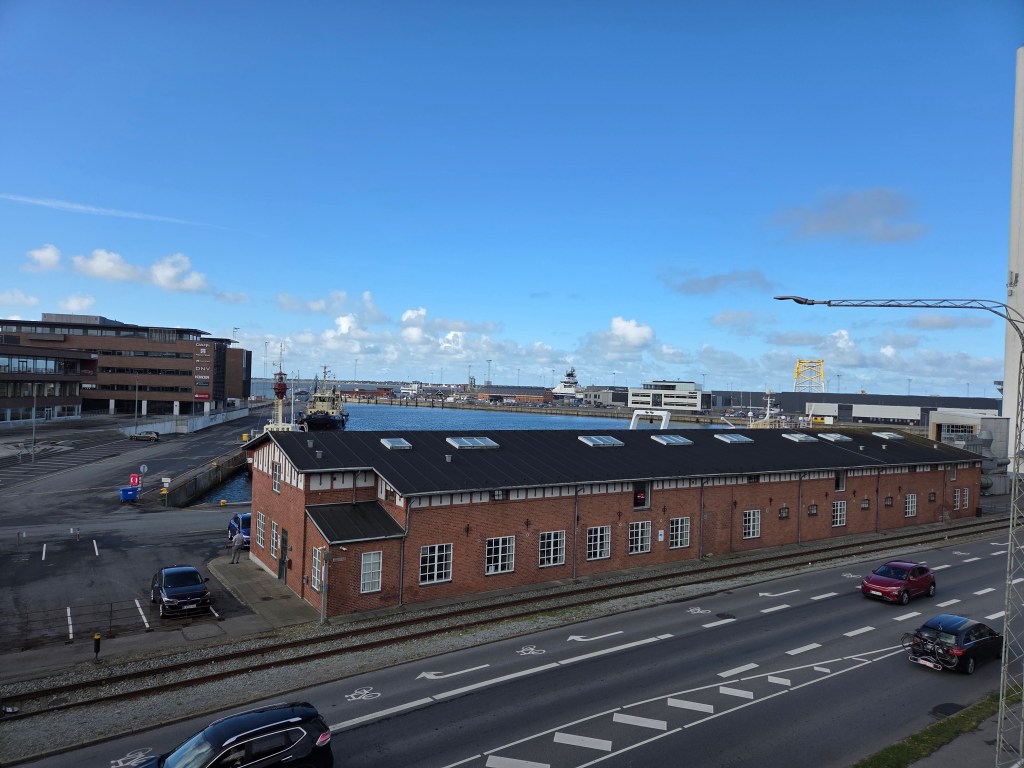
The biggest difference from home (at least what I noticed) was the cycling in cities. Almost every road had a dedicated cycle track running alongside each side of the carriageway. I don’t think I saw one car using the cycle paths to overtake even though they were not physically separated, apart from painted lines. Traffic lights are set to allow for the flow of cycle traffic as well as cars. At many junctions there are more cycles than cars passing through and the lights seem set to account for that, giving longer times for bikes to get through. This means that there is a much smoother movement of bikes. At some places the stream of bikes appears to travel as fast as motorised traffic. This can seem quite intimidating but I would think that once you were accustomed to cycling there it would become an easy and enjoyable way of travel. The variety of cycling styles attests to this. In any group of cyclists there were all sorts, from older cyclists through to parents with children on their own bikes or in child seats or crossbar mounted seats, cargo bikes or towing trailers loaded with children or cargo. There’s also a fair mixture of people in business suits and lycra. Bikes come in all shapes or forms from electric ones to vintage uprights. There’s also a fair smattering of scooters, trikes and even unicycles all taking their riders to and from where-ever.

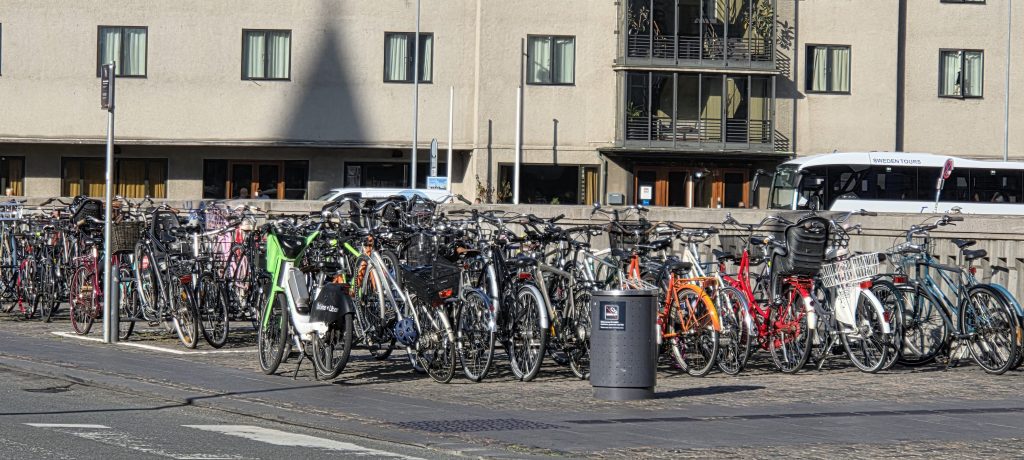
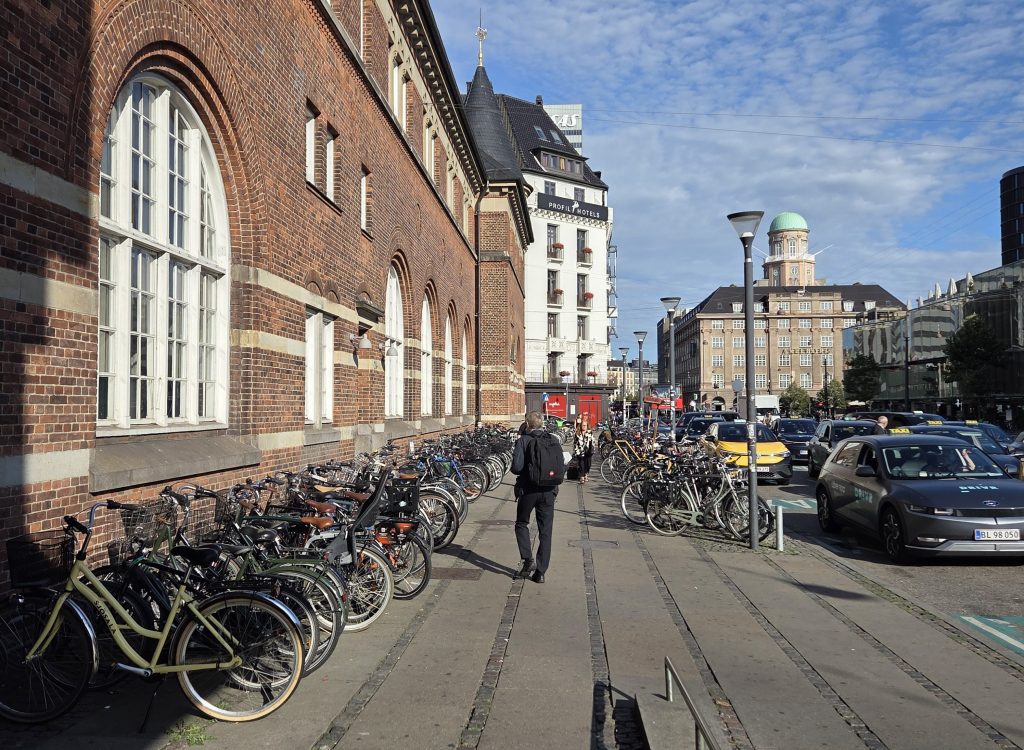
Copenhagen, as Denmarks biggest city, seemed to have the most bikes. Outside the stations and along most streets were thousands of bikes, parked up at all times of day. Even the quieter city centres like Aalborg or Esbjerg had the same level of cycling infrastructure. Both these were less busy in the centres and there were more car free areas. Cycles were not banned from most streets unless it was a designated pedestrian only area. Cyclists and pedestrians seem to be quite capable to get on together, probably due to the fact that there is an understanding of the priority that walkers have over cyclists. Often I would be waiting for cyclists to pass only to realise that they would always stop to let pedestrians go first. It’s something which doesn’t always happen here in Scotland.

A common sight in the smaller towns like Aalborg and Esbjerg are guided cycle tours. These were led by someone with a microphone and the participants all had earpieces. Like the walking tours which are ubiquitous, they could often be seen at scenic spots or waiting for stragglers to catch up. Some of the ones I saw had up to 30 bikes all travelling together. It may be there were tours in Copenhagen too and I just didn’t notice them.

I didn’t spend much time outside the cities so I didn’t get much of a feel of how cycling in the country-side is. I did see publicity for cycle routes, especially around the coasts so I would think that it is quite common and extensive.
cycle parking in Copenhagen
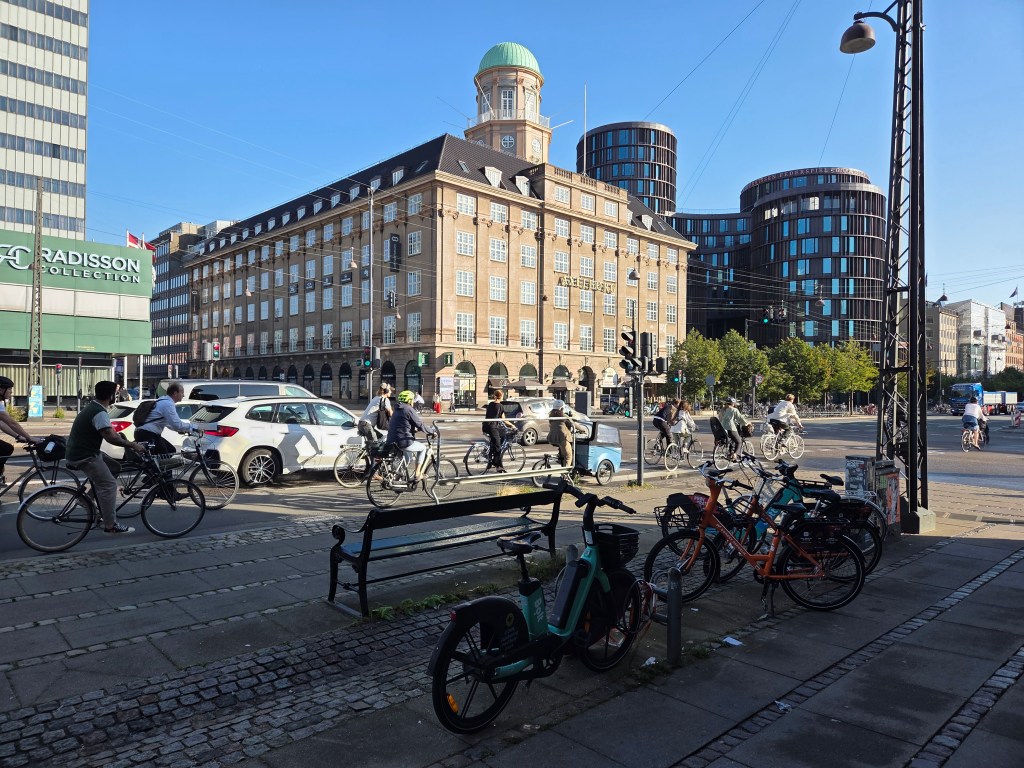
city cycle paths

plans

The summer just hasn’t made any impression this year but I am still hoping for some dry weather and planning to have at least one more trip before autumn.

The Scottish coast to coast route from Annan to Edinburgh looks tempting. Even at my slow pace, I think I’d be able to do it in 3/4 days. I can take the train to Annan and at the other end, either train back from Edinburgh or cycle home along the Forth and Clyde canal. The circular route looks more pleasing to me even though the final day would be a long one.

Since meeting the LEJOG guy on the train from Thurso, I am tempted to think about Lands End to John o’ Groats but that will probably be for another year and will take a lot more planning than I normally put in to my trips. I like to book the train and just go.

orkney

Is a much kinder island for cycling. The roads are a bit less hilly than Shetland and the main ones not quite so busy.

Not that I’m going to do much exploring on my bike, mainly going from one campsite to another. I’ve got a friend also on holiday here with a car so as the weather is still wet, I’ll take advantage of having a chauffeur.

shetland

For starters,  I’ve been here nearly two weeks and no one’s been murdered yet. How inaccurate is that TV drama?

Secondly, Shetland, despite what the Islands tourism industry is trying to push, is not an ideal place for cycling. It’s  a beautiful place, the people are friendly and I will definitely return. Just not on my bike. I may bring a bike with me but for touring, nah.

list

With just a week before I take the ferry to Lerwick, I’m going to write a packing list. That way I may be able to work out, in advance, the best way to fit everything in.

It may mean packing and unpacking a few times before I get it right.

On the other hand I probably will still not be able to find anything and end up with the wrong pannier on the ferry.

UPDATE: I’ve packed everything apart from one or two last minute items, checked my list and now my panniers seem to have much more space left in them than on my last trip. So, have I forgotten something? Missed something from my list? Or maybe I’ve just left out non necessary things. I guess I’ll find out once I’m on my way.

next trip

I’ve decided on my first camping trip for this season.

I’m going to do the Caledonian Way from Oban to Inverness at the end of the month. I have booked train tickets and the Youth Hostel in Oban for the first night. I intend to do it over 3 or 4 days so I can ease myself back into camping. I’m going to use this as a build up fo my summer tip to the Northern Isles.

Looking forward to it and hoping for dry weather.

shoes

I have been looking at cycling shoes for some time and have yet to find an answer to the problem I have with footwear. A couple of years ago I bought my first (and to date, only) pair of cycle specific shoes. These were a pair of Five 10 mountain bike shoes which I used throughout winter on my commute to work. They were solid and offered a lot of protection. The problem with them was that when the weather got better they were too warm. Also, they were not particularly comfortable off the bike. The sole was too stiff to walk in them for more than short periods. So I would revert to wearing walking shoe type trainers for the summer and when I was touring on the bike. I did find that I sometimes wished I had more ankle support when I took a day off cycling and went exploring on foot. I have considered buying light weight walking boots which I can cycle in but so far have not seen anything which fits the bill.

Some cycle shoe manufacturers offer “commuting” shoes which claim to be suitable for walking but they are usually flat-soled as opposed to the “vibram” type tread on walking shoes. Maybe high trainers will be the answer but I don’t want to spend money on something which will not be suitable so will stick with the walking shoes until I find a suitable solution.