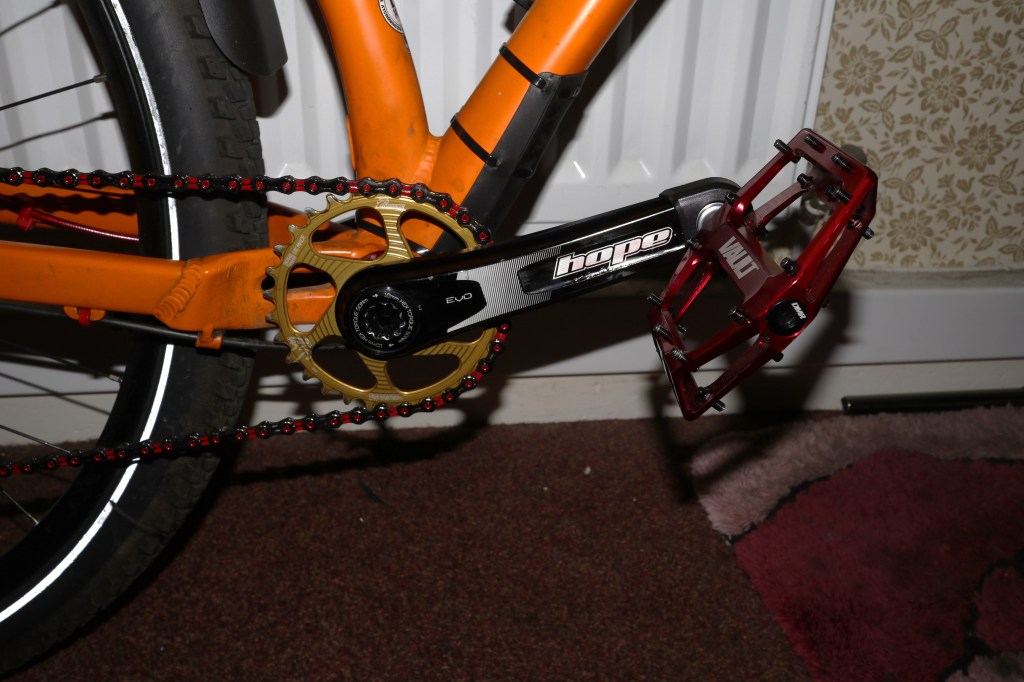
I decided to replace my Shimano cranks with Hope ones for a couple of reasons. I have fitted various Shimano ones on my bikes, usually because I needed particular chain-ring sizes when building or upgrading bikes and have previously gone for the cheaper options. Hope cranks are a lot more expensive than the Shimano ones but this time I decided that price shouldn’t be my prime concern.
Hope cranks, like other components, such as brakes, are much more serviceable than their Shimano equivalents. This means if any part of them breaks or bends the individual components can be replaced without too much difficulty. The Shimano cranks may be replaceable but the axle is press-fitted on to the drive-side arm so must be bought as a complete item.
The cranks I have chosen have a 30mm axle which feels much more robust than the 24mm one Shimano uses. The crank arms also feel much more rigid. They are forged and CNC machined from aluminium alloy which gives them strength. A nice touch is the removal of the shiny coating in areas where rubbing will remove this anyway.
Hope also offer more choice in crank lengths. The range goes from 150mm to 175mm. I went with 165mm ones. I’ve also bought crank boots which will help to protect the crank ends from scuffing.
Fitting the crank-set was fairly straight-forward. The instructions provided with the set are easy to follow but I also had a look at this YouTube video which gives handy, detailed instructions. The bottom bracket needed to be changed and this was a simple enough job. The only thing I have found difficult about fitting the cranks has been removing the axle end caps. I have bought black arms but wanted red end caps to provide a bit of colour. So far I have not been able to remove the factory fitted ones. they seem to be on so tight that I’m worried I may strip the threads if I use too much force. As it’s really only for cosmetic purposes I’ll get round to it eventually. (The instructions I downloaded are a bit confusing. The drive side cover is loosened by turning in a clock-wise direction but the arrows on the cap suggest the opposite. Turns out the arrows are for the hex bolt behind the cap which goes in the opposite direction.)
 Just Me - On my bike