I’ve not long started riding a regular journey. It’s only one day a week but as I have to leave my bike locked to a cycle rack for a few hours, I have had to look at my locks. I’m using my MTB and have a cable lock attached to the frame with velcro straps. This has turned out to be a perfectly adequate solution as long as I don’t have to lock the bike up! The colder weather means that the cable becomes very stiff and therefore awkward to uncoil when I’m trying to feed it through a wheel and the frame. It can take me a good five minutes to lock/unlock my bike and it’s too tempting to not do it properly.
So I’ve decided it’s time to look at buying another lock. I have a link chain lock which is really difficult to carry as it will not attach to my frame due to the bulk. It will fit on the rack of my tourer no problem but it’s not really an answer for the MTB. I have previously tried an ABUS foldable lock but didn’t get on well with it mainly due to the weight and awkward way it unfolded. I then came across an on-line comparison between the ABUS and a Foldylock Compact. The Foldylock came out on top due to it being simpler to use which is down to a different construction in the way the bars are connected. It is also smaller and lighter than the ABUS.
I’ve ordered one and fingers crossed it is an answer to my lock dilemma!
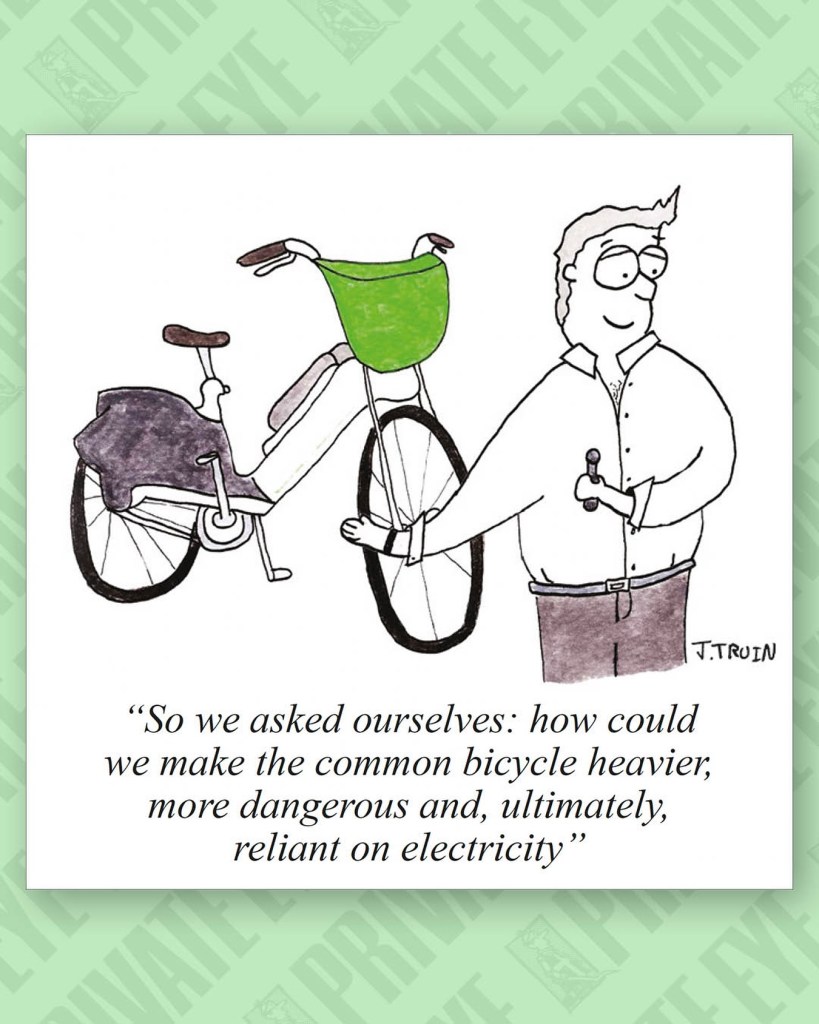
For a while now, and especially after a particularly long, hilly ride into the wind, I have toyed with the idea of getting myself an electric bike. Then I came across the following cartoon from Private Eye and it more or less made my mind up for me.
I have just committed myself to a voluntary position which will entail me cycling there one day a week. As it’s a journey with no straightforward public transport, I’ll need to go by bike no matter what the weather does. So, I’m considering buying new waterproofs. I already have a gore-tex jacket which I have had for lots of years but is a bit past its best. I also have a pair of gore-tex overtrousers. They work well at keeping me dry but are a real pain to take off and put on without first removing my shoes.
The upgraded version of my jacket includes a hood which is something I’ve not really considered before in a cycling jacket. I’m thinking that a hood which fits over my helmet could be welcome, especially as my commute will be along the canal towpath so I won’t have traffic to keep an eye on. When I was cycling regularly I often put off wearing the overtrousers because of the difficulty getting them on after I had set off and a good few times this resulted in me arriving wet.
If I can convince myself that the upgraded waterproofs will be more comfortable it may be easier to also convince myself that I should spend the £300 or so I will be spending.
Following on from my last post, I came across an article here in the Guardian newspaper which sets out how Copenhagen is helping the flow of cycle traffic. It first started about 15 years ago years and they call it the “green wave”. They are hoping to extend it to a further 15 more routes around the city. The hotel I stayed in was on a street adjacent to Nørrebrogade where the first trial is taking place. The sequencing of the lights here was particularly noticeable in keeping cyclists moving. It was intruiging to watch how quickly the cycle traffic was flowing and at the time I wondered how so many cyclists could keep going so smoothly without any build-up and congestion. I would guess that if the authorities in Copenhagen have done proper research (and I’m very confident that they will have), this system will be applied in popular commuter routes but leave others with scope for more leisurely cycling.
I’ve not long returned from spending eight days in Denmark. I visited four cities and travelled between them by inter-city trains. Each of the trains I was on had compartments for cycles. Those needed to be reserved in advance. They were mostly well used with people using them for both short journeys and touring cyclists with camping gear on the longer journeys. The carriages were laid out with fold up seats which the bikes were strapped in front of. As Danish trains are wider than ours this allowed for bikes to be stored on both sides which could allow for up to eight in each carriage. I also noticed that some buses and metro carriages have space for cycles.
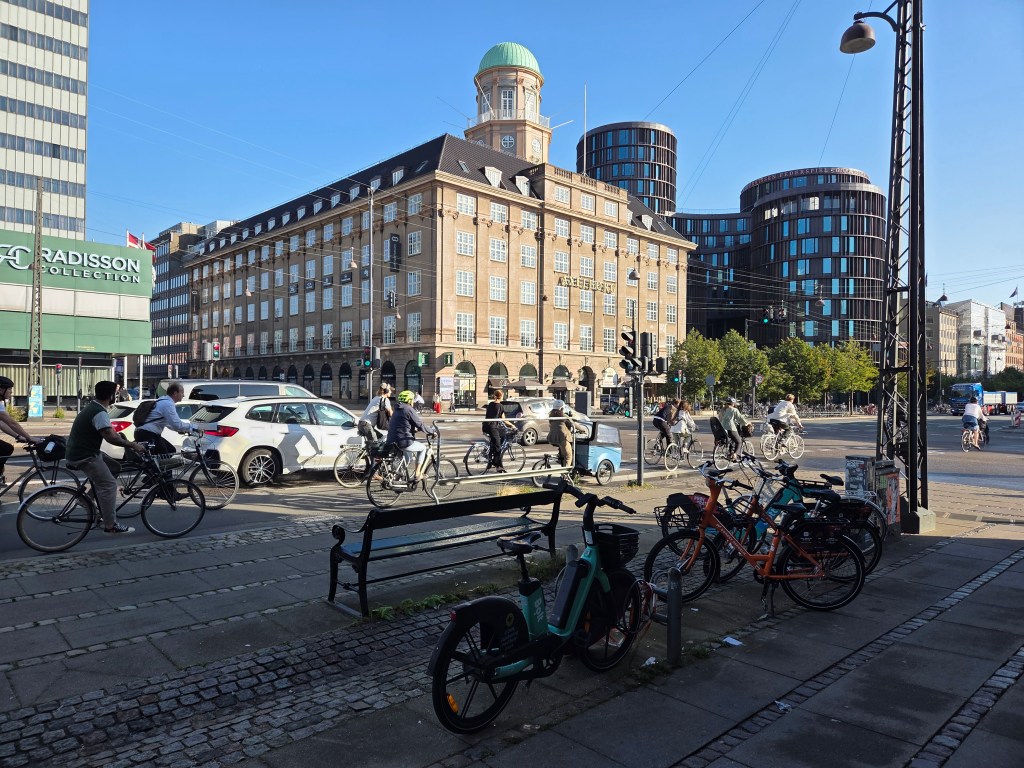
The biggest difference from home (at least what I noticed) was the cycling in cities. Almost every road had a dedicated cycle track running alongside each side of the carriageway. I don’t think I saw one car using the cycle paths to overtake even though they were not physically separated, apart from painted lines. Traffic lights are set to allow for the flow of cycle traffic as well as cars. At many junctions there are more cycles than cars passing through and the lights seem set to account for that, giving longer times for bikes to get through. This means that there is a much smoother movement of bikes. At some places the stream of bikes appears to travel as fast as motorised traffic. This can seem quite intimidating but I would think that once you were accustomed to cycling there it would become an easy and enjoyable way of travel. The variety of cycling styles attests to this. In any group of cyclists there were all sorts, from older cyclists through to parents with children on their own bikes or in child seats or crossbar mounted seats, cargo bikes or towing trailers loaded with children or cargo. There’s also a fair mixture of people in business suits and lycra. Bikes come in all shapes or forms from electric ones to vintage uprights. There’s also a fair smattering of scooters, trikes and even unicycles all taking their riders to and from where-ever.
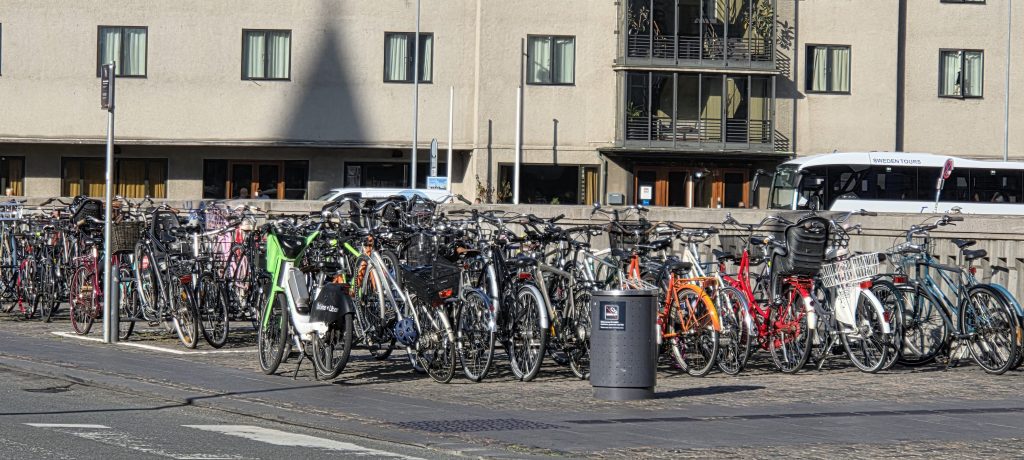
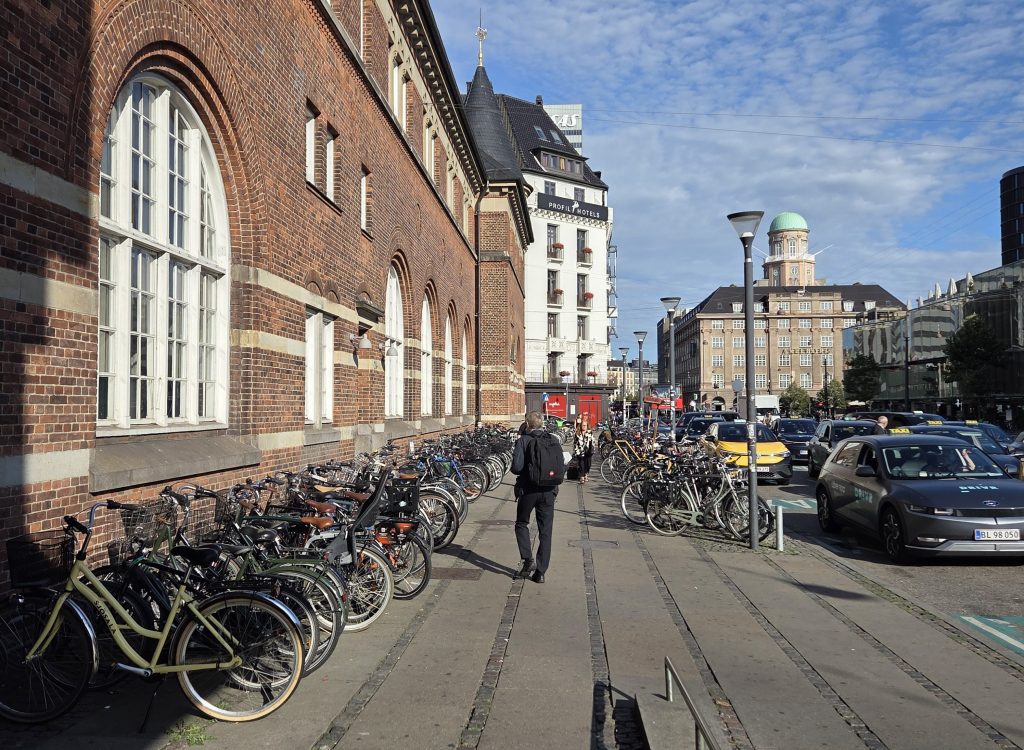
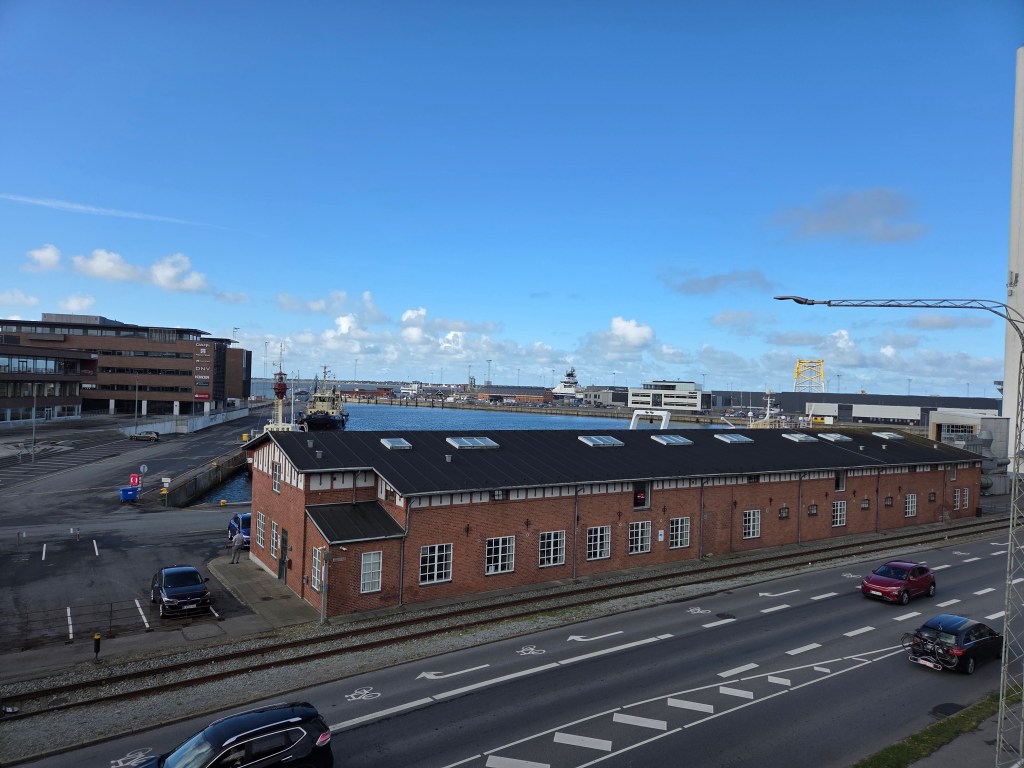
Copenhagen, as Denmarks biggest city, seemed to have the most bikes. Outside the stations and along most streets were thousands of bikes, parked up at all times of day. Even the quieter city centres like Aalborg or Esbjerg had the same level of cycling infrastructure. Both these were less busy in the centres and there were more car free areas. Cycles were not banned from most streets unless it was a designated pedestrian only area. Cyclists and pedestrians seem to be quite capable to get on together, probably due to the fact that there is an understanding of the priority that walkers have over cyclists. Often I would be waiting for cyclists to pass only to realise that they would always stop to let pedestrians go first. It’s something which doesn’t always happen here in Scotland.
A common sight in the smaller towns like Aalborg and Esbjerg are guided cycle tours. These were led by someone with a microphone and the participants all had earpieces. Like the walking tours which are ubiquitous, they could often be seen at scenic spots or waiting for stragglers to catch up. Some of the ones I saw had up to 30 bikes all travelling together. It may be there were tours in Copenhagen too and I just didn’t notice them.
I didn’t spend much time outside the cities so I didn’t get much of a feel of how cycling in the country-side is. I did see publicity for cycle routes, especially around the coasts so I would think that it is quite common and extensive.
The summer is coming to an end and September is just round the corner. I had been hoping to get a 1-2 week cycle/camping trip fitted in this year but have been so busy with one thing or another it just hasn’t been possible. I’m heading to Denmark at the beginning of the month and would have loved to do a cycle tour there. But with there being no ferries between Scotland and Scandinavia nowadays this was possible but just too complicated to organise. Maybe I’ll look into hiring a bike when I’m there, just to experience cycling in Scandinavia. If only to see how it compares to here.
Something I could hope for is a late spell of mild and dry weather at the end of September to allow me to get away and complete maybe another island trip or perhaps the Scottish Coast to Coast ride I’ve been thinking about for the past year. We’ll see when I return but meanwhile I’ll still keep building up the miles day by day.
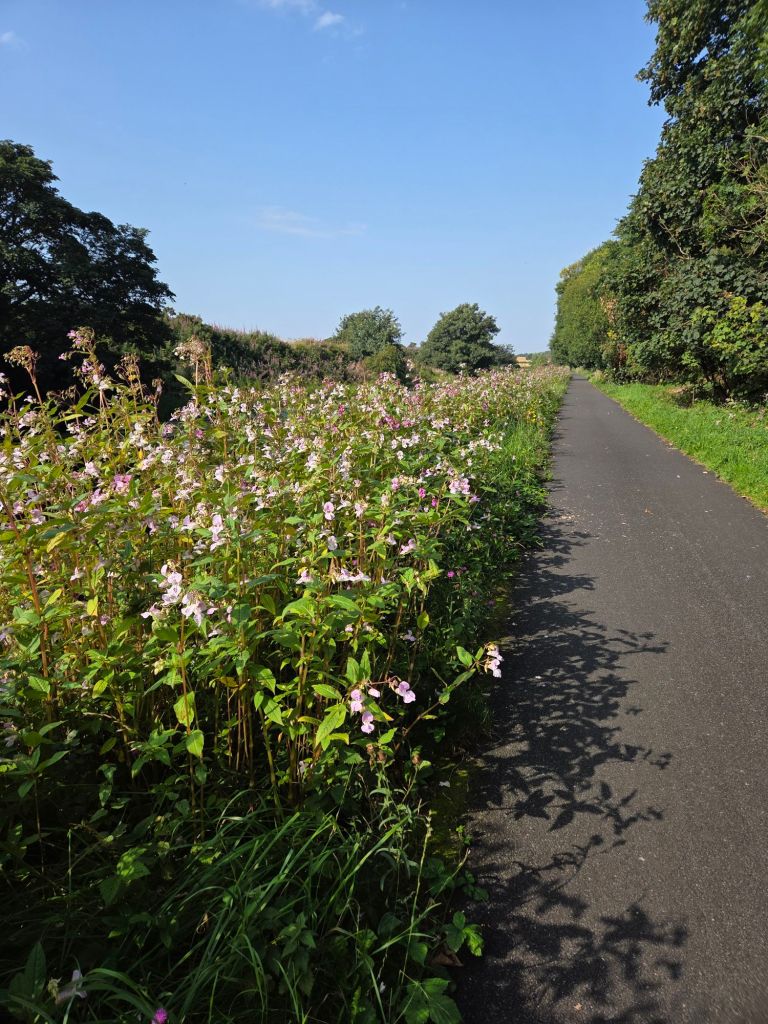
This has become one of my least favourite stretches of the Forth and Clyde canal. In the last two or three years I’ve been cycling along here, the area covered by Himalayan Balsam has more than quadrupled. It gives off a very powerful sickly, sweet scent which makes me feel quite nauseous, especially on a warm day like today.
As this is an invasive species, I’m surprised that there hasn’t been any obvious effort by Scottish Canals to remove it.
The forecast for the next few days is for extremely wet and windy weather. A named storm is on its way so I reckoned I should get out for my cycle today as it may be a few days before I’ll feel like going out again.
I was really pleasantly surprised at how good I was feeling by the time I got back home. I cycled about twenty-six kilometers and could have probably done the same again, had I the time. It’s amazing how fitness can return just as un-noticed as it disappears.
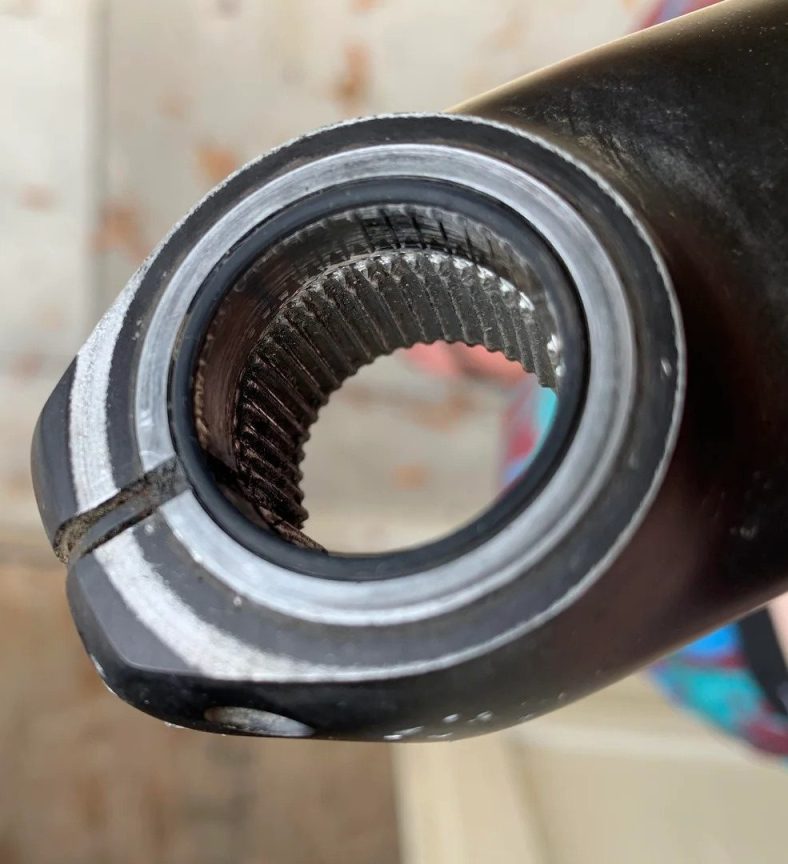
While I was waiting for the replacement crank to arrive I did a bit of research on-line. I found some photos of the same shimano 105 crank arm that I have fitted to the Alice and discovered that it wasn’t stripped after all. The arm’s ribbed section is only on the inner half and the outer section is supposed to be smooth. I’m not sure why it is manufactured like this as it would seem to offer a better grip if the ridges were the complete width of the fitting. As it slips straight on I can’t work out a reason for this.
Anyway, the crank arm seems secure enough. It would appear that I was correct in thinking that I had just not tightened it up securely enough the last time I put it together. Luckily (for once) Amazon had lost the package I ordered and the supplier was good enough to refund my money. So apart from the time I wasted there was no harm done and I learned a worthwhile lesson.
I got away fairly early this morning to get my shopping done in B&Q. I tend to forget how much I carry in the panniers when I’m camping so really shouldn’t have been surprised at how easy it was to bring home the things I needed. I should use the bike for shopping more regularly. It fulfils a dual purpose, getting my excercise in as well as being practical. It also justifies my decision to give up my car.
I was also left wondering if there will ever be a time when I go out on the ALICE and don’t do some tinkering when I get home. This time it’s a slight re-adjustment to the position of the kick-stand. It’s not needing much but on occasions my heel clips it. It’s annoying more than anything else as I automatically adjust the position of my foot. I’ve just got a slight concern that it will work loose after a while.
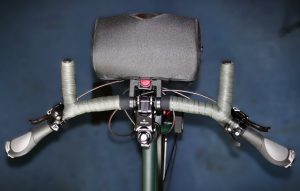
I am also going to place the bell back on the stem. Where it is now gets slightly in the way when I’ve got my hands resting on the horns so the little bit of effort to change position when I need to ring it doesn’t outweight the comfort.
 Just Me - On my bike